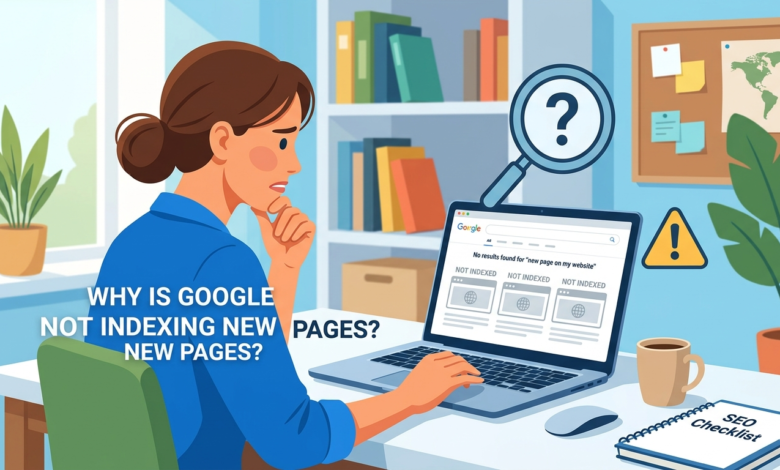
If you are pulling your hair out wondering why google not indexing new pages on your website, you are definitely not alone. Every single day, thousands of webmasters, bloggers, and SEO professionals publish incredible content only to find it sitting in a dark, lonely corner of the internet, completely ignored by Google’s automated web-crawling bots, commonly known as search spiders (Rushton, 2026). It is an incredibly frustrating roadblock because your brilliant pieces cannot start generating traffic, building authority, or making money until they are officially part of Google’s massive database (Chaudhary, 2024).
The mechanics of modern search engines lean heavily on a strict three-step pipeline: crawling, indexing, and finally, ranking (Chaudhary, 2024). When you run into a roadblock where your fresh content is stuck, it means the natural transition from a raw, live URL to an indexed page has been severed somewhere along the line. Understanding why google not indexing new pages requires an expert deep dive into technical roadblocks, core quality assessments, and budget limitations that govern how the search giant manages its storage resources (Lewandowski, 2012).
Let’s demystify exactly why google not indexing new pages on your domain and walk through the exact actionable steps you need to take right now to solve this headache. From fundamental technical misconfigurations to the nuanced algorithmic filters that Google relies on to protect its index from low-quality clutter, we will cover it all to get your content showing up right where it belongs.
1. Technical Roadblocks Blocking Search Spiders
The absolute first place an expert looks when figuring out why google not indexing new pages is the structural or technical framework of the website. If your technical architecture contains instructions that accidentally lock out Google’s automated crawlers, no amount of brilliant writing or high-quality keyword optimization will ever matter. Search engine spiders must be able to move fluidly through your code, and minor, overlooked configuration errors can easily deploy an invisible force field around your newest articles.
+———————+ No +—————————-+
| Google Discovers URL| ———> | Overlooked ‘noindex’ tag? | -> (Fix: Remove tag)
+———————+ +—————————-+
| Yes
v
+———————+ No +—————————-+
| Allowed by Robots? | ———> | Robots.txt blocking path? | -> (Fix: Edit rules)
+———————+ +—————————-+
| Yes
v
+———————+ No +—————————-+
| Crawl Budget OK? | ———> | Server slow / Low Quality | -> (Fix: Boost speed)
+———————+ +—————————-+
| Yes
v
[ Page Indexed! ]
A very common culprit behind why google not indexing new pages is an accidental “noindex” command embedded within your metadata tags or HTTP response headers. This tag explicitly signals to search systems that you want to keep the specific document hidden from public search engine results pages. It is incredibly common for development teams to activate site-wide noindex settings while building or redesigning a website on a staging server, only to completely forget to toggle them off when pushing the platform live.
Another major technical barrier tied directly to why google not indexing new pages involves your site’s robots.txt file, which acts as a strict traffic cop for incoming bots (Rushton, 2026). If this plain text file contains an overly restrictive disallow rule covering your new content folders, Google’s automated systems will respect your instructions and turn away without reading a single line of text (Rushton, 2026). Checking your search console accounts for coverage errors will immediately highlight if a simple technical oversight is the root cause of your visibility issues.
2. Low Quality Signals and Helpful Content Filters

If your technical foundation is completely flawless but you are still stuck asking why google not indexing new pages, you are likely running face-first into Google’s strict algorithmic quality filters. Over the past few years, the search giant has aggressively updated its core evaluation algorithms to combat the overwhelming deluge of low-value, automated, and unoriginal text filling the web (Rushton, 2026). Google does not have infinite storage, so its systems actively decide against the inclusion of documents that fail to deliver meaningful, unique utility to real humans (Lewandowski, 2012).
When diagnosing why google not indexing new pages, you must evaluate your site through the lens of Expertise, Authoritativeness, and Trustworthiness, widely known as the E-A-T framework (Chaudhary, 2024). If an article closely mimics existing digital material without contributing any fresh perspectives, original research, or distinct value, Google’s systems will categorize it as redundant. The search engine would rather save its data resources than copy something it already has safely stored somewhere else in its database.
Furthermore, issues regarding why google not indexing new pages frequently stem from a high concentration of boilerplate text, heavy keyword stuffing, or a chaotic layout saturated with excessive commercial affiliate links or disruptive ad units (Chaudhary, 2024). If your publishing approach prioritizes pushing out dozens of thin, low-effort articles solely designed for search engines rather than actual readers, Google’s systems will flag the pattern. This frequently triggers an indexation hold across your entire site until the overall editorial quality meets their helpful content guidelines.
3. Explaining Crawl Budget and Discovery Delays
For larger web platforms, ecommerce storefronts, or rapidly growing blogs, the explanation for why google not indexing new pages often centers on an exhausted crawl budget. A crawl budget is the finite number of URLs that Google’s search bots are willing and able to request from a specific website during a given timeframe. Google dynamically calculates this budget based on your web server’s speed, your historical publishing consistency, and the underlying popularity or link equity of your overall domain (Lewandowski, 2012; Ziakis et al., 2019).
If your web server responds slowly to incoming bot requests, or if your site architecture forces search spiders to waste processing power navigating thousands of low-value, duplicate parameter URLs, your crawl budget will dry up rapidly. Consequently, when you hit publish on a brilliant new piece of work, it might sit undiscovered for weeks simply because the search engine ran out of assigned resources before its crawlers managed to dig down to your newest link. This operational bottleneck is a primary driver behind why google not indexing new pages on websites that lack clean internal navigation paths.
To break through this resource-driven delay and resolve why google not indexing new pages, you must streamline your discovery pathways. This means maintaining an accurate, updated XML sitemap and building deliberate, prominent internal links from your high-authority, heavily cached cornerstone landing pages straight to your brand-new content (Rushton, 2026; Ziakis et al., 2019). By providing a clear, high-priority digital highway directly to your new URLs, you ensure that search engine bots effortlessly spot and process your fresh material during their limited crawl visits.
Quick Facts Table: Core Diagnostic Check
| Diagnostic Area | Common Technical Culprit | How it Impacts Indexation | Immediate Fix Action |
| Meta Directives | Hidden noindex tag in HTML code | Tells search spiders to explicitly ignore the URL. | Remove the tag from your page layout metadata. |
| Robots.txt | Strict Disallow: rule strings | Completely blocks search spiders from crawling the folder (Rushton, 2026). | Modify the rule lines to open access to search crawlers. |
| Content Merit | Thin, unoriginal, or AI-generated text | Fails helpful content quality filters (Chaudhary, 2024). | Rewrite to add primary research and unique human value. |
| Site Navigation | Orphan pages with no internal inbound links | Search spiders cannot discover the new link (Rushton, 2026). | Add 2 to 3 internal links from high-authority live pages. |
| Server Health | High latency or frequent 5xx errors | Exhausts your crawl budget and forces bots to exit early. | Upgrade hosting resources and optimize page scripts. |
Frequently Asked Questions (FAQ)
How long does Google normally take to index a new page?
For well-established, highly authoritative platforms that publish fresh material on a highly predictable schedule, indexation can happen almost instantly—often within minutes to a few hours. However, for newer web properties or domains with lower overall backlink authority, it is completely normal for discovery and indexing to take anywhere from a few days to several weeks (Yalçın et al., 2010, as cited in Ziakis et al., 2019). If your link remains completely absent from search engine result pages after two weeks, it is a clear sign you need to investigate why google not indexing new pages on your platform using search console diagnostics.
Can I manually force Google to index my new URL?
While you cannot absolutely force the algorithm’s hand, you can explicitly request an expedited review using the URL Inspection Tool inside your Google Search Console dashboard. Paste your target link into the tool’s search bar, let it run a live technical diagnostic scan, and then click the “Request Indexing” action button. This places your specific link directly into a high-priority discovery queue for upcoming crawler assignments. Keep in mind that while this solves technical discovery delays, it will not bypass the underlying quality or duplicate content filters if your text lacks sufficient editorial merit.
Does a high number of HTML syntax errors stop a page from getting indexed?
Surprisingly, minor coding mistakes or unvalidated HTML markup rarely cause indexation failures on their own. Academic research tracking search algorithms has shown that Google’s modern parsing engines are incredibly resilient and possess a high tolerance for everyday HTML syntax variations (Su et al., 2010). The system is highly adept at reading past imperfect code to extract the underlying text, so minor development errors are almost never the true reason why google not indexing new pages on your site, provided the underlying text remains legible and your meta tags are clean.
What is an orphan page, and does it hurt my SEO?
An orphan page is a live document on your website that has absolutely zero internal links pointing to it from any other page within your site’s architecture. Because search spiders primarily discover new content by following existing hyperlink pathways across your domain, orphan pages are incredibly difficult for bots to track down naturally (Rushton, 2026). Leaving new URLs completely isolated without internal link support is a major reason why google not indexing new pages, as the system’s crawlers simply don’t see a clear pathway to discover them during their routine crawls.
Why does Search Console say “Crawled – currently not indexed”?
This specific status message indicates that Google’s search spiders successfully discovered your URL and spent the server resources required to read and evaluate your code. However, after processing the document, the algorithm deliberately chose not to include it in the public search directory. This is rarely a technical breakdown; instead, it is a direct algorithmic judgment on the quality, distinctiveness, or commercial value of your text. To fix this specific issue, you must focus heavily on improving the depth, originality, and helpfulness of your writing rather than tweaking technical configurations.