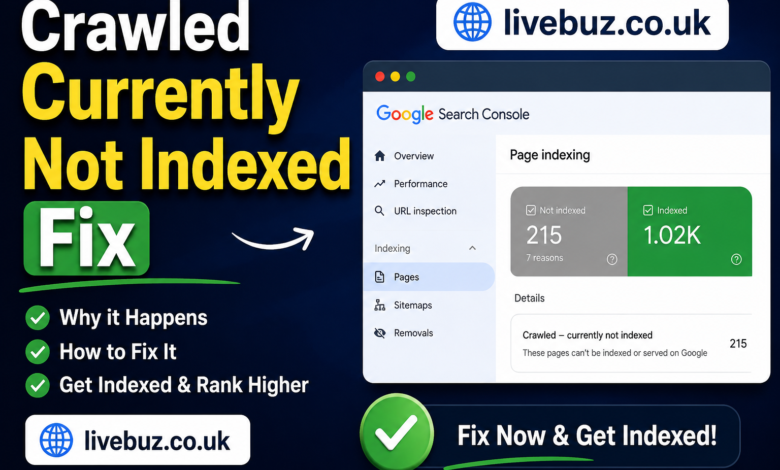
When managing a website, one of the most frustrating issues you might encounter is the “Crawled Currently Not Indexed Fix” status in your Google Search Console. This message indicates that while Google’s crawler has accessed your page, it hasn’t deemed it worthy enough to index. This can significantly affect your site’s visibility in search results. In this article, we will explore the causes of this issue, how to fix it, and best practices to ensure your pages get indexed promptly.
Understanding the Problem
What Does “Crawled Currently Not Indexed” Mean?
When Google crawls your website, it analyzes the content to determine whether it should be included in its index. The status “Crawled Currently Not Indexed Fix” signifies that Googlebot has visited your page but has chosen not to index it at this time. This decision can stem from various reasons, including content quality, relevance, or even technical issues.
Common Reasons for This Status
There are several reasons why your pages might be crawled but not indexed. Here are the most common:
- Low-Quality Content: Google aims to provide users with the best search results. If your content lacks depth, originality, or relevance, it may not be indexed. Pages with thin content, duplicate content, or those that do not provide substantial information may fall into this category.
- Technical Issues: Sometimes, technical problems can prevent indexing. Issues such as slow page load times, server errors, or improper use of the robots.txt file can lead to this status. If Google encounters a technical barrier while trying to index your page, it may opt not to index it at all.
- Site Structure and Navigation: A poorly structured website can impede Google’s ability to crawl and index your pages effectively. If your site has broken links, confusing navigation, or lacks a clear sitemap, Google may struggle to understand the importance of your content.
The Impact of Not Being Indexed
The consequences of having pages that are crawled but not indexed can be severe. It directly affects your site’s visibility in search engines, leading to reduced traffic and potential loss of revenue. Moreover, it can harm your site’s authority, as search engines might view it as less relevant or trustworthy.
Fixing the “Crawled Currently Not Indexed Fix” Issue
Step 1: Assess Your Content Quality
Crawled Currently Not Indexed Fix The first step in fixing this issue is to evaluate the quality of your content. Here are some tips to enhance your content:
- Add Value: Ensure that your content provides valuable insights or information that cannot be easily found elsewhere. This could include detailed guides, original research, or unique perspectives on common topics.
- Improve Readability: Structure your content in a way that is easy to read. Use headings, bullet points, and short paragraphs to enhance clarity. Engaging visuals can also break up text and keep readers interested.
- Avoid Duplicate Content: Check for duplicate content issues, both within your site and across the web. Tools like Copyscape can help identify duplicate content, allowing you to make necessary changes.
Step 2: Address Technical Issues
Next, you should identify and resolve any technical issues that might be affecting indexing:
- Check Server Response Codes: Use tools like Google Search Console or website crawlers to check for server response codes. Ensure that your pages return a status of 200 (OK) rather than 404 (Not Found) or 500 (Server Error).
- Optimize Page Speed: Page speed is a ranking factor, and slow loading times can deter indexing. Use tools like Google PageSpeed Insights to analyze your page speed and implement recommendations to improve it.
- Review Robots.txt and Meta Tags: Ensure that your robots.txt file does not block Google from accessing your pages. Additionally, check for any meta tags, such as “noindex,” that might inadvertently prevent indexing.
Step 3: Improve Site Structure and Navigation
A well-structured website helps both users and search engines navigate your content easily. Here’s how to improve your site’s structure:
- Create a Clear Hierarchy: Organize your content into categories and subcategories. This helps Google understand the relationship between different pages and their importance.
- Use Internal Linking: Internal links help distribute page authority throughout your site. Link to relevant articles within your content to guide users and search engines to your most important pages.
- Generate an XML Sitemap: An XML sitemap provides search engines with a roadmap of your website. Submitting your sitemap to Google Search Console can help ensure that your pages are indexed correctly.
Frequently Asked Questions (FAQ)
Q1: How long does it take for Google to index my pages?
A1: The time it takes for Google to index new pages can vary. Generally, it can take anywhere from a few days to several weeks. Factors such as the quality of your content, the frequency of updates, and your site’s authority can influence this timeframe.
Q2: Will fixing the “Crawled Currently Not Indexed” status improve my rankings?
A2: Yes, improving the quality of your content and addressing technical issues can enhance your rankings. Indexed pages are more likely to appear in search results, leading to increased visibility and traffic.
Q3: What should I do if my pages remain unindexed after making changes?
A3: If your pages remain unindexed after implementing changes, consider resubmitting them through Google Search Console. Additionally, keep monitoring your site’s performance and continue making improvements.
Conclusion
Dealing with the “Crawled Currently Not Indexed Fix” issue can be challenging, but with a systematic approach, you can resolve it effectively. By focusing on content quality, addressing technical issues, and improving your site structure, you can increase your chances of getting your pages indexed. Remember that patience is key; indexing can take time, but the effort you put into fixing these issues will pay off in the long run.
Table: Summary of Fixes for “Crawled Currently Not Indexed”
| Issue | Solution |
| Low-Quality Content | Enhance content value, readability, and originality |
| Technical Issues | Check server response, optimize page speed, review robots.txt |
| Poor Site Structure | Create a clear hierarchy, use internal linking, generate an XML sitemap |
By following these guidelines, you’ll be well on your way to resolving the “Crawled Currently Not Indexed” issue, boosting your site’s visibility, and enhancing user experience.