Delta Flight DL275 Diverted LAX Today: What Happened, Why the Flight Changed Course, and What Passengers Need to Know

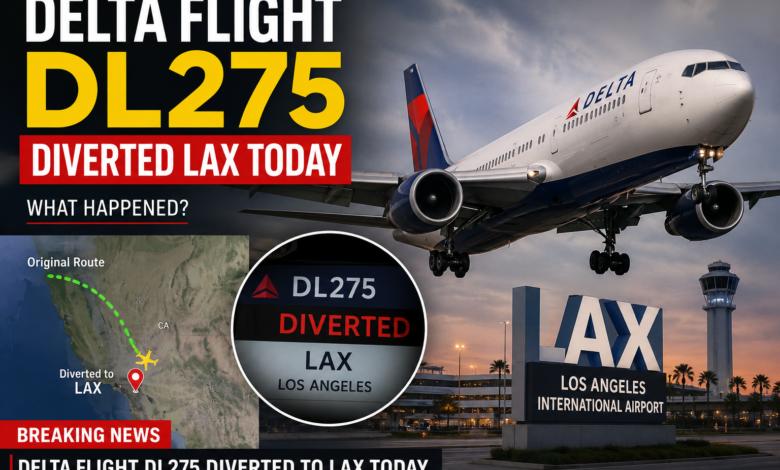
Delta Flight DL275 Diverted LAX Today has become a widely searched topic, with travelers looking for reliable information about the flight, the reason for the diversion, and its impact on passengers. While many websites contain conflicting details, the confirmed information points to a safety-related diversion involving Delta Air Lines Flight DL275 operating between Detroit Metropolitan Wayne County Airport (DTW) and Tokyo Haneda Airport (HND). Public reporting consistently identifies a diversion to Los Angeles International Airport (LAX) after the crew received an indication related to the aircraft’s engine anti-ice system. However, many specific figures and claims circulating online remain unverified.
Overview of Delta Flight DL275
Delta Flight DL275 Diverted LAX Today is a scheduled long-haul international service connecting Detroit with Tokyo Haneda. The route is typically operated using the Airbus A350-900, one of Delta’s flagship wide-body aircraft designed for long-distance trans-Pacific operations.
Flight Information
- Flight Number: DL275
- Airline: Delta Air Lines
- Route: Detroit (DTW) → Tokyo Haneda (HND)
- Aircraft: Airbus A350-900
- Diversion Airport: Los Angeles International Airport (LAX)
Why Was Delta Flight DL275 Diverted LAX Today?
According to multiple aviation reports, the flight crew detected an indication involving the aircraft’s engine anti-ice system while crossing the Pacific Ocean. Because long over-water flights require conservative safety decisions, pilots elected to divert rather than continue across thousands of miles of ocean. Public reporting consistently references an anti-ice system warning, although detailed technical findings have not been officially released.
Pilots are trained to prioritize passenger safety above schedule. Even when an aircraft remains fully controllable, any system affecting engine protection on an ETOPS route deserves careful evaluation.
Why Was Los Angeles Chosen Instead of Another Airport?
Many travelers wondered why the aircraft continued to Los Angeles instead of landing at a closer airport.
Several operational factors likely influenced the decision:
- Delta has extensive maintenance facilities at LAX.
- Replacement crews and customer support are readily available.
- The airport routinely handles Airbus A350 aircraft.
- Passenger rebooking options are significantly better at a major Delta hub.
Large international airports also simplify customs coordination, aircraft inspections, and onward travel arrangements.
Timeline of the Diversion
Although exact timestamps differ among unofficial reports, the overall sequence remains consistent.
- DL275 departed Detroit for Tokyo.
- The aircraft climbed normally and proceeded over the Pacific.
- Flight crew identified a technical indication.
- Standard operational procedures were followed.
- Pilots diverted toward Los Angeles.
- The aircraft landed safely.
- Maintenance inspections were performed.
- Passengers received assistance with onward travel.
No verified reports indicate injuries during the diversion.
Was There an Emergency?
A diversion does not necessarily mean the aircraft was in immediate danger.
Commercial airlines frequently divert flights for reasons including:
- Mechanical indications
- Medical emergencies
- Weather conditions
- Airport operational issues
- Fuel planning considerations
Modern aircraft are designed with multiple redundant safety systems, allowing crews to make precautionary decisions before a situation becomes critical.
Passenger Experience
Passengers aboard DL275 likely experienced:
- Updated announcements from the cockpit
- Revised arrival expectations
- Ground assistance after landing
- Flight rebooking where necessary
- Possible hotel accommodations depending on travel schedules
Delta generally works to minimize disruption following unexpected operational events.
How Airlines Handle Technical Diversions
When a system warning appears, pilots work closely with:
- Airline Operations Control
- Maintenance specialists
- Air Traffic Control
- Dispatch teams
Together they evaluate:
- Aircraft performance
- Weather
- Distance to suitable airports
- Maintenance capability
- Passenger safety
Safety—not convenience—drives the final decision.
Aircraft Safety Systems
The Airbus A350 incorporates advanced monitoring systems that continuously check aircraft performance.
These systems can detect abnormalities long before they become major problems, allowing crews to make precautionary decisions.
Examples include:
- Engine monitoring
- Hydraulic systems
- Electrical systems
- Flight control systems
- Environmental controls
- Anti-ice protection
Early detection contributes significantly to aviation safety.
Common Questions
Was anyone injured?
Publicly available reports indicate that the aircraft landed safely and no injuries were reported.
Did the aircraft declare an emergency?
Public reports do not clearly confirm an emergency declaration. The diversion appears to have been conducted as a precautionary safety measure.
What happens after a diversion?
The aircraft undergoes inspection by maintenance engineers before returning to service. Passengers are then rebooked or accommodated based on operational availability.
Are flight diversions common?
Diversions are uncommon but occur regularly across global aviation whenever safety or operational considerations make an alternate airport the better option.
Lessons From the DL275 Diversion
The incident demonstrates several important aspects of modern aviation:
- Safety always comes before schedule.
- Aircraft monitoring technology detects issues early.
- Pilots follow established international procedures.
- Major airports provide the resources needed for efficient recovery.
- Modern commercial aviation remains one of the safest forms of transportation.
Although diversions can inconvenience passengers, they reflect the aviation industry’s commitment to preventing minor issues from developing into larger problems.
Conclusion
The Delta Flight DL275 diverted LAX today search trend highlights how quickly aviation events attract public attention. Based on publicly available information, the diversion involved a Delta Airbus A350 operating from Detroit to Tokyo that safely diverted to Los Angeles following reports of an engine anti-ice system indication. While many online articles include conflicting or unverified details, the consistent takeaway is that the flight landed safely and the crew followed established safety procedures.
For travelers, the event serves as a reminder that flight diversions are precautionary decisions intended to protect everyone on board. In commercial aviation, choosing the safest option is always the highest priority.